
St. Croix County Criminal Court Cases
The Wisconsin Circuit Court in St. Croix County hears state felonies and criminal misdemeanors. Its four branches operate from the St. Croix County Government Center in Hudson. Municipal courts in Hudson, New Richmond, and River Falls instead hear civil ordinance and traffic forfeitures. A municipal citation may create a city court file without creating a Wisconsin state criminal prosecution.
The St. Croix County Clerk of Circuit Court files pleadings, enters judgments, records proceedings, schedules hearings, processes warrants, retains files, and reports dispositions. That makes the Clerk the source for official copies and non-online material. The District Attorney files the prosecution, but the DA is not the custodian of the full court record.
Four St. Croix Criminal Court Branches
The 2025 to 2026 county directory lists Branch I Judge Scott J. Nordstrand, Branch II Judge Brian T. Smestad, Branch III Presiding Judge Scott R. Needham, and Branch IV Judge R. Michael Waterman. All four branches share one Clerk record system. A branch assignment identifies the court handling the case; it does not create a separate public search portal.
For the official office description, use the St. Croix County Clerk of Courts page.
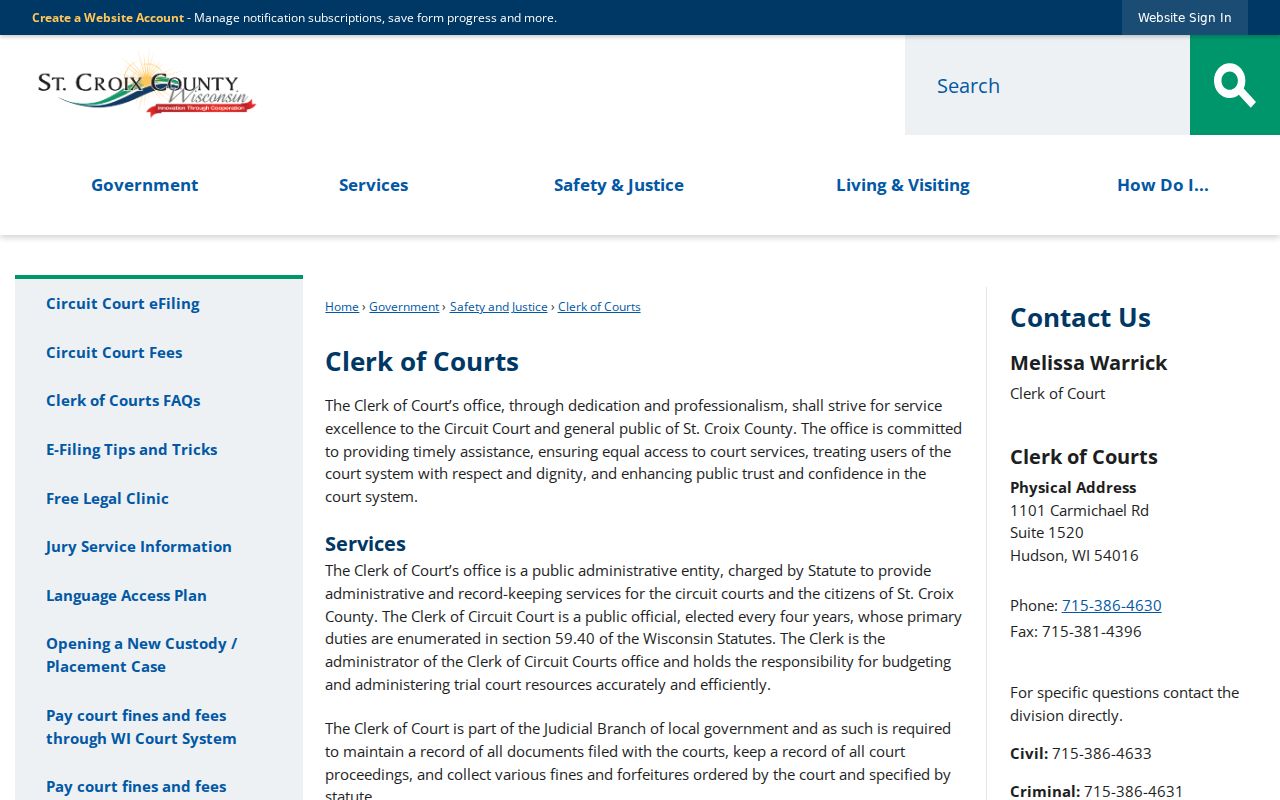
The Clerk’s counter in Suite 1520 connects each branch’s public case record to copy, certification, payment, and archive services.
Clerk of Circuit Court
1101 Carmichael Road, Suite 1520
Hudson, WI 54016
715-386-4630
Monday-Friday, 8:00 a.m.-4:30 p.m.
Criminal Division
St. Croix County Government Center
Hudson, Wisconsin
715-386-4631
Case files and criminal copy questions
Note: The assigned branch identifies the trial court, while the Clerk remains the records custodian for all four branches.
Searching St. Croix County Case Records
The official Wisconsin judiciary case-search entry page leads to Wisconsin Circuit Court Access, commonly called WCCA or CCAP. The system is free and statewide. Restrict the result to St. Croix County, then compare the case number, filing date, case type, and available party context. A name match is a lead, not proof that the case concerns the person intended.
- Open the judiciary case-search route and proceed to WCCA.
- Search with the available party name or case identifier.
- Limit or verify the result as St. Croix County.
- Open the summary and read charges, docket events, judgment, and sentence separately.
- Call Clerk Criminal at 715-386-4631 for missing documents, certified copies, or older files.
The JavaScript interface can change, so the documented search inventory does not promise a fixed control layout. These are the stable search choices and verification points supported by the official record workflow.
| Search item | Use | Required | Verification note |
|---|---|---|---|
| Party name | Find possible cases | One search route | Check identity context and county |
| Case identifier | Open a known file | Alternative route | Match the full case number |
| St. Croix County | Narrow results | Verify | Do not rely on a same-name case elsewhere |
| Case type and status | Read the summary | After opening | Distinguish criminal from civil or municipal matters |
| Filing and event dates | Build the timeline | After opening | Later entries may change the result |
Note: WCCA is a public court docket, not a fingerprint-confirmed Wisconsin history report or a current St. Croix County custody list.
St. Croix Criminal Case Copies
When WCCA shows a docket entry but not the document, ask the St. Croix County Clerk for the file. Supply the name, filing year, case type, and case number if known. The Clerk charges $1.25 per copied page. Certification adds $5, and a clerk search costs $5 per name per case type. A certified judgment is the stronger source when a person needs to reconcile the outcome shown in a state repository record.
The official St. Croix County Circuit Court fee page publishes these copy, certification, and search charges.
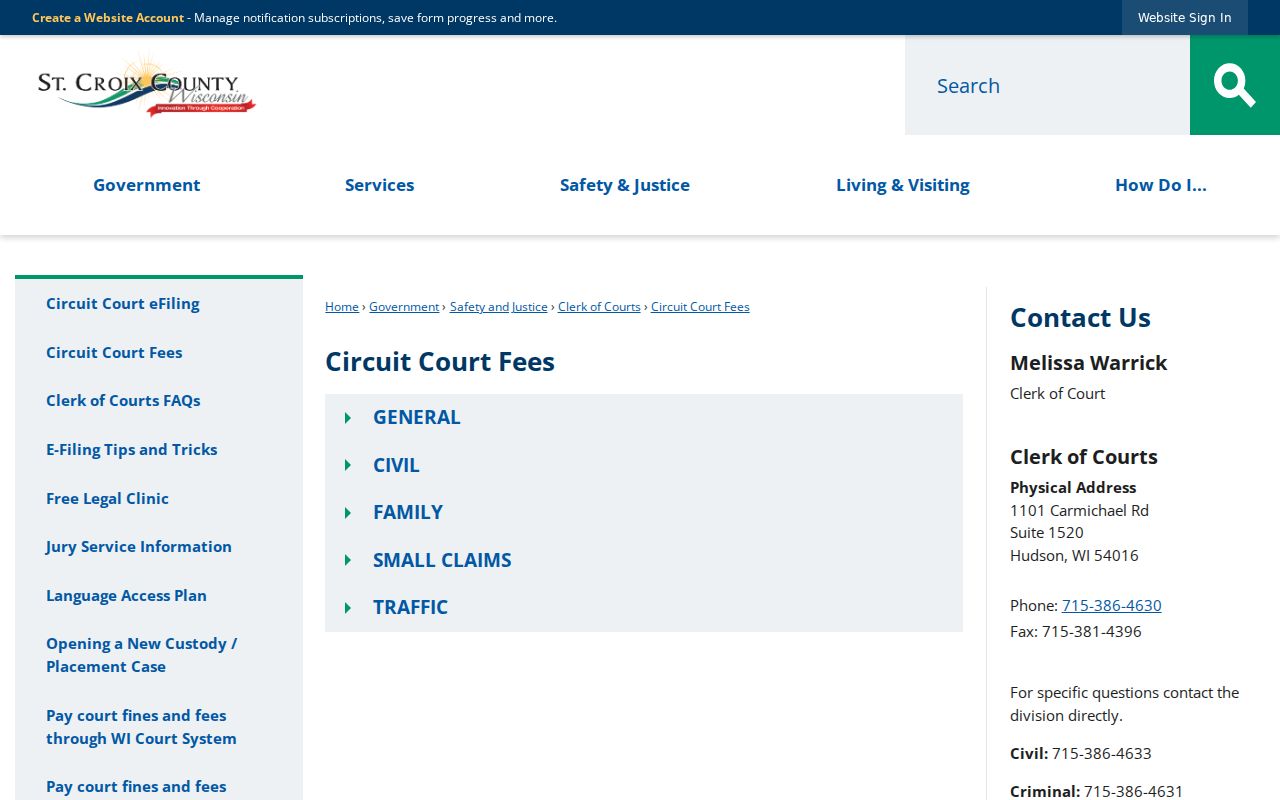
The fee source helps separate a public online lookup from an official paper or certified court record.
| Court service | Amount | When it helps |
|---|---|---|
| File copy | $1.25 per page | Obtaining a document not shown online |
| Certification | $5 additional | Confirming an official court copy |
| Clerk search | $5 per name per case type | Locating a file when details are incomplete |
Inside a St. Croix County Case File
A criminal case file can show the case number, county, filing date, type, status, assigned branch, parties, attorneys, charges, cited statutes, severity, offense date, plea, disposition, hearing schedule, financial entries, public documents, judgment, and sentence. Docket events may record the complaint, initial appearance, bond, arraignment, motions, plea, trial, warrant activity, judgment, and sentencing.
Read each count on its own. One charge may be amended, another dismissed, and another resolved by plea or trial. The filed complaint reflects an allegation. The disposition states the result. The sentence follows a conviction and can include custody, supervision, financial obligations, or other public terms.
| Case number and court | Identifies St. Croix County, the case type, filing sequence, and assigned branch. |
|---|---|
| Charging document | States the prosecutor’s filed allegations and supporting facts. |
| Docket entries | Build a dated record of filings, hearings, orders, and warrant events. |
| Hearing details | Show published date, time, type, and courtroom information. |
| Disposition and judgment | Record the outcome of each charge and the formal judgment. |
| Sentence and financials | May show sentence terms, fines, costs, restitution, and public balances. |
Note: A charge line remains an allegation until its disposition is read, and each count can reach a different outcome.
Reading St. Croix Criminal Case Outcomes
Four terms prevent common mistakes. A complaint is the prosecutor’s charging document. A plea is the defendant’s formal response. A disposition is the outcome of a particular charge. A sentence is the court-ordered consequence after conviction. Those fields can appear far apart on a long docket, so the first charge line should never be treated as the final result.
- Arraignment
- The hearing at which charges are formally addressed and a plea is entered.
- Dismissal
- The end of a charge without a judgment of guilt.
- Acquittal
- A not-guilty result after trial.
- Disposition
- The recorded outcome for one charge.
- Bench warrant
- A judge-issued warrant often linked to failure to appear or comply with an order.
A court case may exist even when WORCS has no matching event. CIB depends on supporting fingerprints and later reporting. The reverse can also occur when a repository arrest segment arrives before a case is filed. Compare records as a timeline and avoid treating a delay as proof of error or guilt.
How a Criminal Case Moves
A St. Croix County criminal case begins in the court file when the District Attorney files charges. The initial appearance addresses rights, the charge, and release conditions. Later proceedings can include arraignment, pretrial conferences, motions, negotiations, a plea, or trial. The court then enters a disposition for each count and, after a conviction, imposes sentence. Exact timing depends on the case and court orders; the local research supports no universal completion estimate.
Case flow: Charges Filed › Arraignment › Pretrial › Plea or Trial › Disposition › Sentencing
The earlier arrest and booking records remain separate. They can describe an initial allegation that differs from the complaint. For custody context before filing, use the official St. Croix County arrest lookup channels; for the legal outcome, return to the court docket and Clerk file.
St. Croix Treatment Court Records
St. Croix County Treatment Court is an intensive, multiphase therapeutic program for people with substance dependence and substantial risk of reoffense or failure. Documented eligibility includes county residency, age 18 or older, and specified pending felony drug, substance-related, or felony OWI circumstances. Related misdemeanors are reviewed case by case. Statutory violent offenders under Wis. Stat. §165.95 are excluded.
An attorney or Wisconsin DOC Division of Community Corrections agent must refer the person, and the participant must apply. Status hearings are held Wednesdays at 8:30 a.m.; the coordinator can be reached at 715-386-4723. Treatment Court does not erase the underlying public case. Program events and the disposition must be read through the court record.
Pretrial Services in Suite 2400 is also distinct. It uses Public Safety Assessment and COMPAS tools and may support court-ordered check-ins, reminders, testing, GPS, or service referrals. These are local case-management tools, not separate criminal dockets.
Case Record Access and Restrictions
Wisconsin law favors public access to court records, but public does not mean unredacted. Juvenile matters, victim-sensitive information, protected identifiers, expunged material, sealed filings, and other restricted documents may be absent or redacted. Online WCCA access can also be narrower than the Clerk-held file. Contact the St. Croix County Clerk when a known document is not displayed.
Wis. Stat. §19.35 governs public inspection and copying, including authorized actual costs. Supreme Court Rule Chapter 72 sets court-record retention categories. A custodian still applies specific confidentiality law and the required public-policy analysis to the record requested.
Record check: Confirm the case number, county, charge-level disposition, and latest docket event before relying on a St. Croix County criminal case result.
Expungement under Wis. Stat. §973.015 is narrow and generally must be ordered at sentencing for an eligible offense and person. A dismissal or successful diversion outcome is not automatic expungement. If a CIB record lacks a court disposition, obtain a certified judgment from the Clerk and use the Wisconsin DOJ challenge process for one’s own record.
Note: Missing online content does not establish that no record exists; ask the Clerk about the specific known file.
St. Croix Criminal Records After Expansion
The Government Center’s completed 2025 expansion added courtrooms, jury-deliberation areas, conference rooms, public-service counters, and improved space for the District Attorney, Victim/Witness, and Sheriff. County materials connect the work to projected growth of 41.1 percent from 2010 through 2040. The project changed the space available for court service, while the official Clerk and WCCA channels remained the key record routes.
The local court system now combines four Circuit Court branches, one Clerk record operation, Treatment Court, and civilian Pretrial Services at the Hudson campus. That structure helps explain why the branch, program, and custodian fields each answer a different question. The branch hears the matter. A named program may shape supervision or case progress. The Clerk maintains the filed record and supplies certified copies.