
Checking Criminal History in Hudson
A useful Hudson records check starts by naming the event and its likely custodian. Hudson Police can supply releasable reports about events its officers handled. Hudson Municipal Court is the place for Hudson citations and ordinance matters. The St. Croix County Jail and Wisconsin Circuit Court Access serve different roles once a Hudson arrest or state charge moves into county systems. Wisconsin DOJ then provides a broader, name-based repository check through WORCS.
Use this order to avoid mistaking one slice of a Hudson record for the whole history:
- Contact the Hudson Police Records Unit for the incident, investigation, accident, or traffic-citation record. Give a case number when available.
- Ask Hudson staff for the specific releasable report and a date range, rather than asking them to answer a broad question.
- Call Hudson Municipal Court when the matter is a city ordinance or traffic forfeiture case.
- Use the St. Croix jail portal for current Hudson custody and WCCA for a state criminal case filed in Circuit Court.
- Use WORCS when a statewide Wisconsin name check is needed, and review possible name matches with care.
The county-wide St. Croix criminal-history overview explains how those systems differ. A search with no result is not proof that no record exists, since timing, fingerprints, jurisdiction, and record restrictions all affect what appears.
Hudson Records at Vine Street
The Hudson Police Department works from 101 Vine Street, Hudson, WI 54016, in the same building as the Hudson Area Joint Library. The Hudson public line is 715-386-4771, the fax is 715-386-4266, and office hours are Monday through Friday from 7:30 a.m. to 4:30 p.m. After hours, centralized dispatch answers at 715-386-4701. That shared Hudson library-and-police building is a practical local landmark for anyone visiting the records counter.
The official Hudson Police source shows the department page used for local criminal-record contact information.
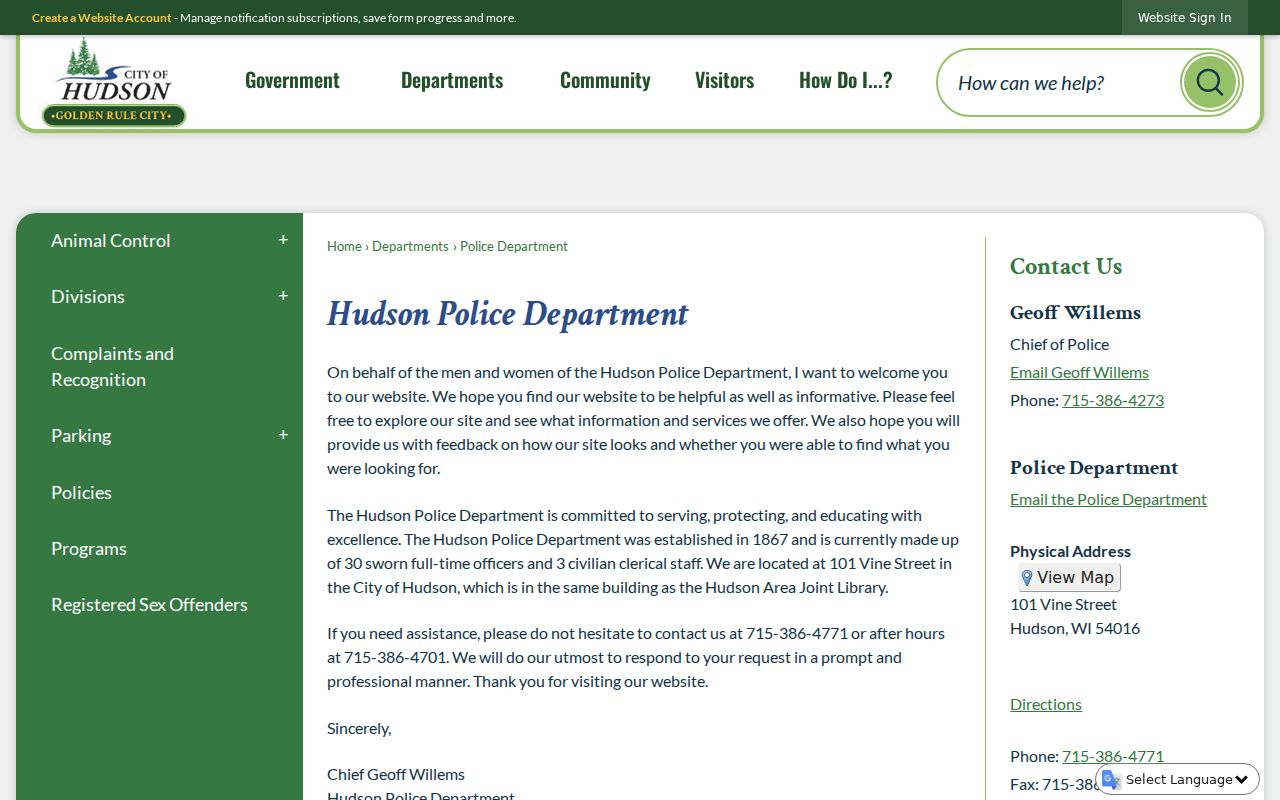
The image points to the Hudson agency that owns its officer reports even when a person was later booked at the county jail.
Hudson Police Department Records
Hudson Police dates to 1867. Chief Geoff Willems leads a department with 30 full-time sworn officers and three civilian clerical staff, according to city material. Its Records Unit maintains criminal investigations, incident reports, accident files, and traffic citations. It also compiles state and federal statistics plus monthly and annual reports. Those functions explain why a records request may be routed by record type instead of treated as one broad criminal-history search.
Call or email the Hudson unit before visiting, and provide the case number when it is known. A focused Hudson request should identify the event, date or date range, location, and preferred format. The unit may redact protected details or withhold material when a specific law or the public-interest balancing test requires it. County booking staff do not become custodians of the Hudson officer’s narrative merely because the person entered the jail.
Hudson Police Records Unit
101 Vine Street
Hudson, WI 54016
715-386-4771
Monday-Friday, 7:30 a.m.-4:30 p.m.
Hudson Police Record Volume
The Hudson department’s 2024 annual report counted 19,854 calls for service. That was about five percent above both the five-year average of 18,925 and the 2023 count of 18,975. The same report estimated 85,000 transient people in Hudson on an average day, far beyond its estimated resident population of 15,706. Hudson's place in the Twin Cities orbit helps explain why police workload cannot be read from resident population alone.
A Hudson call for service is not the same as a crime, arrest, or conviction. It can reflect a noncriminal request for help, a traffic event, an alarm, or another response. The Hudson report also lists 5,458.92 training hours. Those figures add context to Hudson records volume, but they should not be used to label every Hudson police contact as criminal activity.
Note: Annual workload totals describe department activity, while an individual Hudson criminal record must be confirmed through the record that documents that event.
Hudson Arrests and Bookings
Hudson has no separate public city detention lookup documented in the research. When Hudson Police makes an arrest that leads to county custody, Hudson booking information routes to the St. Croix County Jail at the Government Center. The official Zuercher Public Safety Portal provides the current county roster and open-warrant function. If a Hudson listing is unclear, call the jail at 715-386-4752. Custody data can change quickly, so phone confirmation matters for bond, release, or court-time questions.
The police report and jail entry are related but distinct. Hudson Police holds the incident narrative and initial allegations. The jail records intake, booking time, custody status, holding allegations, and bond. The district attorney later decides whether and what to charge. A filed state case then appears through WCCA, sometimes after the booking is already visible.
For a full discussion of those county sources, use the St. Croix County arrest lookup. No booking entry, arrest allegation, or officer report by itself proves guilt.
Hudson Citations Versus Crimes
Hudson Municipal Court has exclusive jurisdiction over city ordinance and traffic forfeiture matters. A forfeiture is a civil monetary penalty, not a Wisconsin state criminal conviction. That distinction matters because a Hudson citation may never appear in WCCA, even though the municipal court can take a plea, enter judgment, set payment terms, or use authorized enforcement steps after nonpayment.
State felony and misdemeanor charges from Hudson are filed in St. Croix County Circuit Court. Search WCCA for those Hudson cases, then obtain official copies from the county clerk when the online docket does not provide the needed document. The same conduct can produce a Hudson police report and a municipal citation without creating a state criminal case. Start with the issuing document and court name rather than assuming every Hudson police contact belongs in CCAP.
| Hudson channel | What it holds | Legal character |
|---|---|---|
| Municipal Court | City traffic and ordinance citations | Civil forfeiture matters |
| St. Croix Circuit Court | Filed state felony and misdemeanor cases | Wisconsin criminal cases |
| Hudson Police | Incident, investigation, accident, and citation records | Agency records, subject to access review |
Municipal Court Records in Hudson
Hudson Municipal Court is at City Hall, 505 Third Street. Judge Kyle Schaffer presides, and Clerk Delaina Bacon-Gaboury can be reached at 715-716-5737. The initial court date is printed on the citation, and the citation indicates when appearance is mandatory. A person with a nonmandatory appearance may use the city’s plea and payment channels instead.
A default judgment follows when the cited person does not respond as required, and Hudson describes a 60-day payment expectation. Nonpayment can lead to measures such as Department of Transportation suspension or tax intercept. Hudson payment options include AllPaid with PLC 4073 at 1-888-604-7888. For municipal pretrial, Hudson Police report copies cost 25 cents per page plus sales tax, must be prepaid, and are picked up at 101 Vine Street.
| Court Name | Hudson Municipal Court at City Hall |
|---|---|
| Case Types Heard | City ordinance and traffic forfeiture matters |
| Case Lookup Channel | Municipal court clerk and city plea or payment forms |
| What the File Shows | Citation, plea, appearance status, judgment, and payment or enforcement events |
| Police Report Copies | 25 cents per page plus sales tax for municipal pretrial, prepaid |
Hudson OWI Jury Transfers
Hudson has an unusual route for an OWI or prohibited-alcohol-concentration citation when the cited person seeks a jury. The municipal matter transfers to St. Croix County Circuit Court for a jury only if the written request and required fees reach the court within ten days. Missing that procedural window can change where and how the matter proceeds.
This transfer rule does not turn all Hudson citations into Circuit Court cases. It is a defined Hudson procedure tied to an eligible jury request. Confirm the deadline and required payment with the Hudson municipal clerk rather than relying on a general WCCA search. Once transferred, the Circuit Court docket becomes the right place to follow the state-court record.
Where Hudson Records Go
A Hudson arrest begins with a Hudson police report. A qualifying Hudson booking sends fingerprints and arrest data into the state collection process. If the St. Croix County district attorney files a Hudson state charge, the Clerk of Circuit Court creates the case and later reports its disposition. Each stage may use a different charge description because the officer, prosecutor, and court make separate decisions.
Record flow: Hudson Police Department › St. Croix County Circuit Court › Wisconsin Department of Justice Crime Information Bureau
Recent activity may appear first in a Hudson report or the county jail roster. WCCA reflects filed prosecution and court events. WORCS searches the fingerprint-supported Wisconsin repository by name, so reporting time and identity matching can create differences. Compare dates, county, and identifiers before concluding that two entries belong to the same person.
Hudson Default Judgment Records
A Hudson default judgment is the municipal court’s decision after a person fails to respond or appear as required. It is not a Hudson arrest record, and it should not be described as a state criminal conviction. Still, it can create real Hudson enforcement events, including payment obligations and the consequences the city identifies for nonpayment.
If an expected Hudson citation record is not in WCCA, contact the municipal clerk. Ask for the citation or case by name, date, and citation number if known. If the case instead involves a filed state charge, use WCCA and the St. Croix County Clerk Criminal Division. This two-channel check resolves one of the most common Hudson record-search errors.
Note: AllPaid is a payment channel for eligible municipal obligations, not a public portal for a complete Hudson criminal-history search.
Hudson Police Record Types
The Hudson Records Unit’s categories help a requester ask for the right document. A Hudson incident report records a response or reported event. A criminal-investigation file can contain follow-up work and may face access limits while a matter is active. A Hudson accident report concerns a crash. A traffic citation documents the alleged Hudson or state traffic violation and identifies the issuing path.
- Incident record
- The report tied to an officer response, event number, date, place, and narrative.
- Investigation record
- Case material created during criminal investigative work, subject to redaction and access review.
- Accident record
- The agency record of a reported crash and related facts.
- Traffic citation
- The charging document that directs a matter to municipal or another specified court.
Ask for a named Hudson record rather than “everything” about a person. A narrow Hudson request helps the custodian find responsive material and estimate lawful copy or location costs.
Public Access Rules in Hudson
Hudson Police and the municipal court apply Wisconsin’s presumption of access record by record. An ordinary request generally does not need a stated purpose, but it should reasonably identify the requested document and time period. Protected identifiers, juvenile information, victim-sensitive facts, and material covered by a specific confidentiality rule can be redacted or withheld. When public parts can be separated, redaction is preferred to withholding the entire record.
Key Statutes:
Wis. Stat. §19.35 grants inspection and copying rights and sets rules for permissible actual costs.
Wis. Stat. §165.83 governs criminal-information collection by the state repository.
Wis. Stat. §165.84 explains fingerprint reporting duties that affect repository coverage.
A written denial should state its legal and public-policy reasons. Requesters can narrow the date range, subject, and format to reduce search or reproduction work. Neither public access nor an online result guarantees that a record is complete, current, or free of lawful redactions.